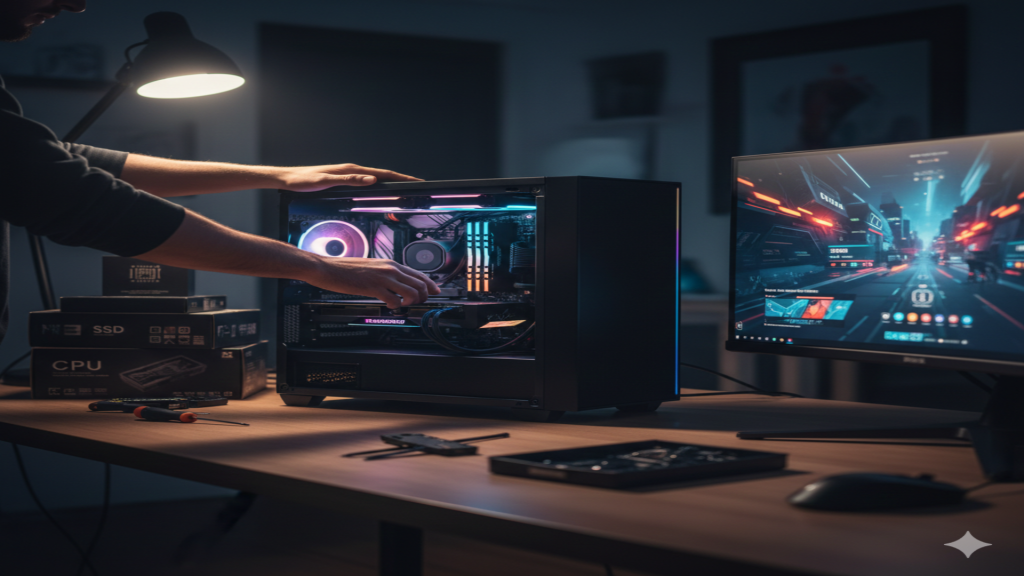
Ask five PC nerds “what matters for gaming” and you’ll hear “single-core clocks!” and “threads!” and “it’s the cache, dude.” In 2026, the clean answer is: clock speed still matters, but cache (X3D) changed the meta completely.
Let’s cut through the fanboy noise and look at what actually matters for your gaming performance.
The current state of play in 2026
AMD’s dominance in pure gaming
Independent roundups still place Ryzen X3D parts at the top of pure gaming leaderboards. The Ryzen 7 9800X3D remains a go-to “plug and forget” winner for frames and frame-time stability. It’s not flashy, but it works.
- Consistent top rankings in gaming benchmarks
- Excellent 1% low frame times (smooth gameplay)
- Great cache architecture (3D V-Cache)
- Proven reliability in competitive gaming
- Platform longevity (AM5 socket getting long-term support)
AMD’s mixed-use option (work + gaming)
The Ryzen 9 9950X3D trades blows with 9800X3D in games while adding significant multi-thread grunt. For someone who games heavily but also streams, edits video, or renders-this is the power choice.
Many reviews show they swap wins at 1080p and converge at higher resolutions. If your GPU is the bottleneck (which it usually is), the 9950X3D feels like overkill for pure gaming. But if you need the cores, it doesn’t sacrifice gaming performance to get them.
Intel’s position in 2026
Intel’s latest desktop stack is still competitive (and often cheaper mid-range), but for strict gaming crowns, most charts point to AMD’s cache chips. Intel hasn’t figured out how to beat X3D’s cache advantage.
- Competitive pricing in mid-range (good value)
- Strong single-core performance (esports advantage)
- Newer manufacturing (13th/14th gen efficient)
- Good for CPU-heavy workloads outside gaming

Single-core vs cache – what’s the real impact?
This is where it gets interesting. High clocks and IPC (Instructions Per Cycle) shine in esports and CPU-bound moments. But huge L3 cache feeds the engine better in open worlds, heavy draw-call scenes, and “big simulation” games.
High clocks (Intel’s strength)
When it matters:
- Esports games (Valorant, CS2) where CPU is limiting factor
- High framerates (240+ FPS) at 1080p resolution
- Older games with dated optimization
- Competitive scenarios where every frame matters
Impact: 5-15% FPS improvement in CPU-bound scenarios. Real advantage for competitive gaming.
Large cache (AMD X3D’s strength)
When it matters:
- AAA open-world games (Baldur’s Gate 3, Starfield)
- Heavy draw-call scenes (complex environments)
- Games with “big simulation” (lots of physics, NPCs)
- High resolutions (1440p, 4K) where GPU is bottleneck
Impact: Fewer CPU cache stalls, steadier 1% lows, smoother frame times. The difference feels like less stuttering and more consistent gameplay.

The real-world comparison
Head-to-head pieces repeatedly show 9800X3D matching or beating higher-core chips in games. While the 9950X3D exists for gamers who also crush renders and encodes.
| Scenario | AMD Wins | Intel Wins |
| Pure gaming (no other workload) | 9800X3D | Not really |
| Gaming + streaming/rendering | 9950X3D | Not applicable |
| Competitive esports (1080p high FPS) | Similar performance | Slightly cheaper |
Platform notes that actually matter
AMD AM5 platform (long-term value)
AM5 keeps getting lifespan love from AMD. Easy BIOS updates and drop-in X3D upgrades are a selling point if you like to keep boards long-term. This is huge for value-in 3 years, you could drop a new CPU into your existing motherboard.
Intel’s platform (reset cycle)
Intel’s desktop cadence in 2026 includes Arrow Lake refresh now with bigger moves later. If you want the absolute best gaming chip today, most buyer guides push 9800X3D. Intel doesn’t have a clear roadmap advantage here.

Quick picks for different needs
Pure gaming (no heavy creation)
Ryzen 7 9800X3D
Consistent top charts, great 1% lows, excellent value. This is the gaming CPU of 2026.
Gaming + serious productivity
Ryzen 9 9950X3D
Trades gaming wins with 9800X3D, adds cores for work. Perfect for creators who game seriously.
Value mid-range
Intel Core i5/i7 refreshes
Can be cheaper if you don’t chase absolute max FPS-and if the bundle price (board + DDR5) is right in your region. Not the best, but solid value.

Bottom line
Cache is king for gaming, clocks still help, and core-count beyond 8 is mainly about your workloads.
For pure gaming in 2026, AMD X3D wins. For mixed workloads, AMD still wins but with more cores. For value and competitive esports, Intel can compete. For long-term platform value, AM5 is the better bet.
Your choice boils down to: Do you game and nothing else? Get 9800X3D. Do you game and create? Get 9950X3D. Do you want cheapest option and don’t mind slightly lower gaming performance? Intel works.
Building from scratch? Start with our complete gaming PC build guide for the full part-by-part breakdown.
Frequently Asked Questions
Is AMD really better than Intel for gaming in 2026?
For pure gaming frame rates, yes — Ryzen X3D chips consistently top independent benchmarks thanks to their large cache. Intel remains competitive for mixed gaming-plus-productivity workloads.
Does clock speed matter more than cache for gaming?
Cache has closed most of the gap. A high clock speed still helps, but X3D-style cache now has a bigger real-world impact on 1% lows and frame consistency.
Should I upgrade my CPU or my GPU first?
In almost every case, GPU first. A mismatched CPU rarely bottlenecks gaming performance as hard as an outdated GPU does.