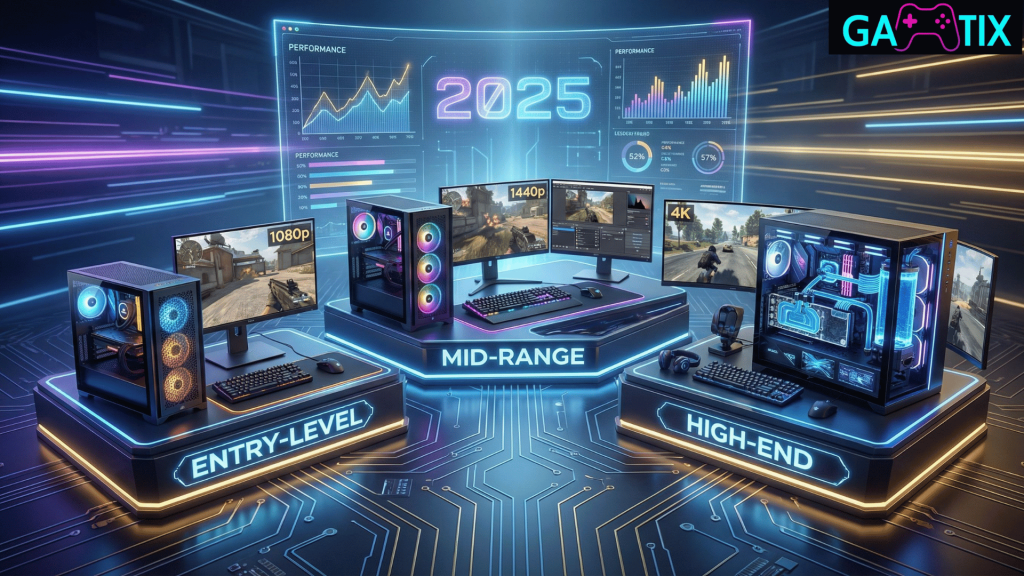
[IMAGE: NVIDIA RTX 50-series and AMD RDNA 4 graphics cards displayed side by side – 1920×1080]
Let’s skip the fanboy wars and talk like real builders: what’s actually worth your money in 2026. Pricing’s volatile, supply is weird, and marketing is louder than ever. But if you shop by resolution + VRAM + power, you’ll land a great card without drama.
The 2026 backdrop (what changed)
NVIDIA’s 50-series is the current yardstick: 5090/5080 at the top, 5070 Ti/5070 holding the performance mainstream, and 5060/Ti down in value land. Blackwell architecture + DLSS 4 is the headline.
The rumored “SUPER” refresh? Don’t hold your breath — NVIDIA outright said no new GPUs at CES 2026, focusing on features instead. They’re basically saying the lineup is complete.
AMD RDNA 4 showed up to contest the mid-range with RX 9070 XT/9070 (16GB) and shifted attention to affordable SKUs when memory costs spike—plus FSR 4 to counter DLSS. AMD’s strategy is clear: undercut NVIDIA’s prices in the mid-range.
TL;DR: Expect green to lead at the cutting edge (4K, ray tracing, AI features), and red to pressure pricing in the mid-range.
[IMAGE: GPU performance comparison chart NVIDIA vs AMD by price tier – 1024×576]
1080p winners (budget to mid)
Best overall (1080p high refresh)
GeForce RTX 5070 (12GB)
The modern default for 1080p max settings and even 1440p medium/high, with DLSS 4 as a legit “free frames” lever. This is the card everyone should buy if they game at 1080p and want years of headroom.
Value alternative
Radeon RX 9070 (16GB)
AMD’s mid-stack aims squarely here, often undercutting equivalent NVIDIA cards while keeping 16GB VRAM for future textures and mods. If price is right, this is the smart AMD choice at 1080p.
Why these win: Esports and lighter AAA loads favor newer frame-gen stacks + decent VRAM. NVIDIA’s software stack is stronger, AMD pushes price/perf and capacity.
1440p winners (the sweet spot)
Best for 1440p high/ultra
RTX 5070 Ti (16GB)
It’s the tier built for 1440p with ray tracing on and DLSS 4 smoothing the dips. This is what 1440p gaming looks like done right.
AMD price fighter
RX 9070 XT (16GB)
Official launch put it squarely against the 1440p crowd, with RDNA 4 emphasizing ray tracing uplift vs last gen. If you don’t need NVIDIA’s software features, this is cheaper.
Why: At 1440p, you see the AI-upscaling advantage and benefit from 16GB VRAM. AMD’s sticker price can be friendlier if ray tracing isn’t your must-have.
[IMAGE: 1440p gaming performance comparison NVIDIA vs AMD with DLSS vs FSR – 1024×576]
4K winners (no-compromises tier)
Enthusiast pick
RTX 5090 (32GB)
Absurd throughput, heavy power draw, and it really wants a 1000W-class PSU with proper 12V power. This is the ultimate “I don’t care about price” card.
Balanced flagship
RTX 5080 (16GB)
Launched at $999 with major perf uplift generation-to-generation. If you game at 4K with upscaling, this is the practical high-end “daily driver.” Smart money at 4K.
Why: DLSS 4 + ray reconstruction + frame gen is the real deal at 4K where raw pixels overwhelm. AMD’s RDNA 4 focus this cycle is mid-range, so halo 4K still leans green.
Supply & pricing curveballs you should know
Mid-range availability is choppy thanks to memory constraints and priority shifting toward AI hardware, impacting some 50-series SKUs. Don’t be surprised if your card choice isn’t in stock.
AMD’s RDNA 4 cadence targets value first; top-end responses may lag, keeping NVIDIA comfy at 4K for a while. This means if you need 4K performance, NVIDIA is safer.
Simple buying map (2026)
Pick your resolution first, then choose the GPU:
| Resolution | First Choice | Budget Alternative |
| 1080p high refresh | RTX 5070 | RX 9070 if price is right |
| 1440p | RTX 5070 Ti for “no-worry” RT | RX 9070 XT if price/perf > RT |
| 4K | RTX 5080 (smart) or 5090 (ultimate) | AMD isn’t competitive here yet |
Your move
Pick the resolution you actually play at, then match VRAM and power. Don’t buy based on memes.
NVIDIA wins at 4K and has better software features. AMD wins on price in the mid-range. Both have solid cards in 2026. Your choice should be based on your monitor resolution and budget, not brand loyalty.