Choosing a graphics card in 2026 feels harder than it should be. New architectures, confusing naming, marketing hype makes simple decisions complicated. This guide cuts through the noise.
The graphics card market in 2026
NVIDIA dominates performance and ray tracing. The RTX 50-series (Blackwell architecture) is the performance leader. DLSS 4 with frame generation is the killer feature that separates NVIDIA from everyone else. AMD’s RDNA 4 competes in the mid-range where value lives. The RX 9070 XT and 9070 with 16GB VRAM are solid alternatives when you’re not chasing absolute highest framerates. FSR 4 counters DLSS but still lags slightly in optimization. Intel’s Arc GPUs exist but haven’t convinced enough gamers to switch.

Choose your GPU by resolution
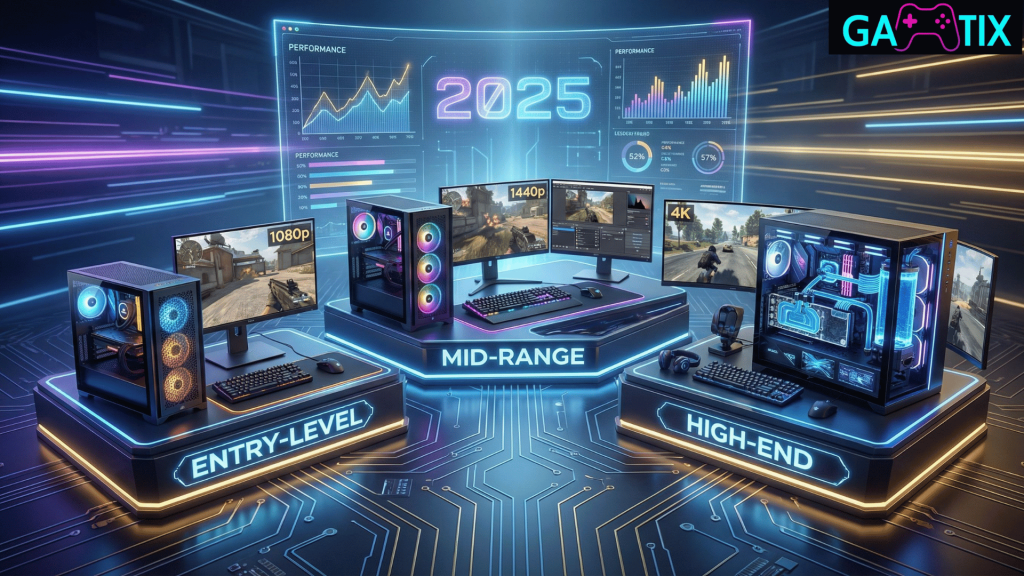
Your monitor resolution determines your GPU needs more than anything else.
1080p gaming: Mid-range dominates
Modern mid-range GPUs hit 100+ FPS at 1080p high settings in nearly every game. If you’re playing competitive shooters or esports, 1080p paired with a high-refresh monitor is the smart choice. Best choice: RTX 4070 or RX 7700 XT. Performance here is stupid good. You’ll never feel limited.
1440p gaming: The sweet spot
1440p has become gaming’s Goldilocks zone. Not as demanding as 4K. Dramatically better looking than 1080p. High-refresh 1440p gaming with max settings is achievable with upper-mid cards. A good 1440p card costs $400-700. You’ll get 60+ FPS in modern AAA games, 100+ FPS in esports titles, and 1-2 years of headroom before needing to upgrade. Best choice: RTX 4070 Ti or RX 9070 XT. This is where value meets performance perfectly.
4k gaming: High-end territory
4K is visually stunning. It’s also merciless on hardware. Even flagship GPUs need DLSS or FSR at 4K to maintain 60+ FPS. Game developers have learned that raw resolution matters less than frame generation quality. DLSS 4 frame generation is what separates competent 4K gaming from stuttering disappointment. Practical choice: RTX 5080. No-compromise choice: RTX 5090.

VRAM: More than a spec sheet number
Yes, VRAM matters. But not always in the way people think. You genuinely need abundant VRAM if you’re playing massive open-world games (Baldur’s Gate 3, Starfield), pushing extreme texture mods, or chasing 4K maximum details. If you’re mostly playing esports or indie games? 8GB VRAM is fine. Don’t overpay for 16GB VRAM on a mid-range card when 8GB delivers the same gaming performance for that card’s purpose.
Power consumption and thermals
Performance per watt matters. A GPU that needs 450W of power and runs at 95°C under load limits your PSU options and kills system longevity. Read actual reviews for real thermal numbers, not just peak boost clocks. A quiet GPU at 70°C is better than a jet engine at 85°C.

CPU pairing matters more than people think
A budget GPU on a high-end CPU is fine (the GPU will be your bottleneck). A high-end GPU on a budget CPU is a waste (the CPU will bottleneck the GPU). Match GPU and CPU tiers. You don’t need perfection, but pairing a $1500 GPU with a $200 CPU is foolish.

Real-world advice
Don’t buy based on speculation about future games. Buy based on what you want to play now. Don’t get caught in resolution wars. Your preference matters more than forum arguments. Some people prefer 1440p 144Hz over 4K 60Hz, and both choices are valid. Don’t chase VRAM you won’t use. Don’t cheap out on power supplies just to afford more GPU. Don’t ignore thermals in reviews. The best GPU for you is the one that plays the games you enjoy at the settings you prefer for a price you can justify.
Building from scratch? Start with our complete gaming PC build guide for the full part-by-part breakdown.
Frequently Asked Questions
What GPU should I buy for 1440p gaming in 2026?
An RTX 4070 Ti or RX 9070 XT-class card is the current sweet spot for high-refresh 1440p at max or near-max settings.
Does VRAM matter more than raw GPU power?
Only past a certain threshold. Extra VRAM helps in massive open-world games and heavy texture mods, but won’t fix a GPU that’s simply too weak for your target settings.
Is DLSS or FSR a reason to pick one brand over the other?
For many players, yes — DLSS 4’s frame generation is currently ahead of FSR 4 in image quality, which matters most at 4K.